Listen to the louder channel.
Independent active full-wave rectifiers feed a loudest-channel link. Opposing stereo signals cannot cancel in a summed detector. The sidechain HPF changes what drives compression; it leaves the audio path intact.
02 / STEREO BUS COMPRESSOR
PRECISION VCA / MAGNETIC SIGNAL PATH
Original stereo compression.
An interacting signal and control circuit.
WINDOWS x64 · VST3 + STANDALONE · v0.1.1
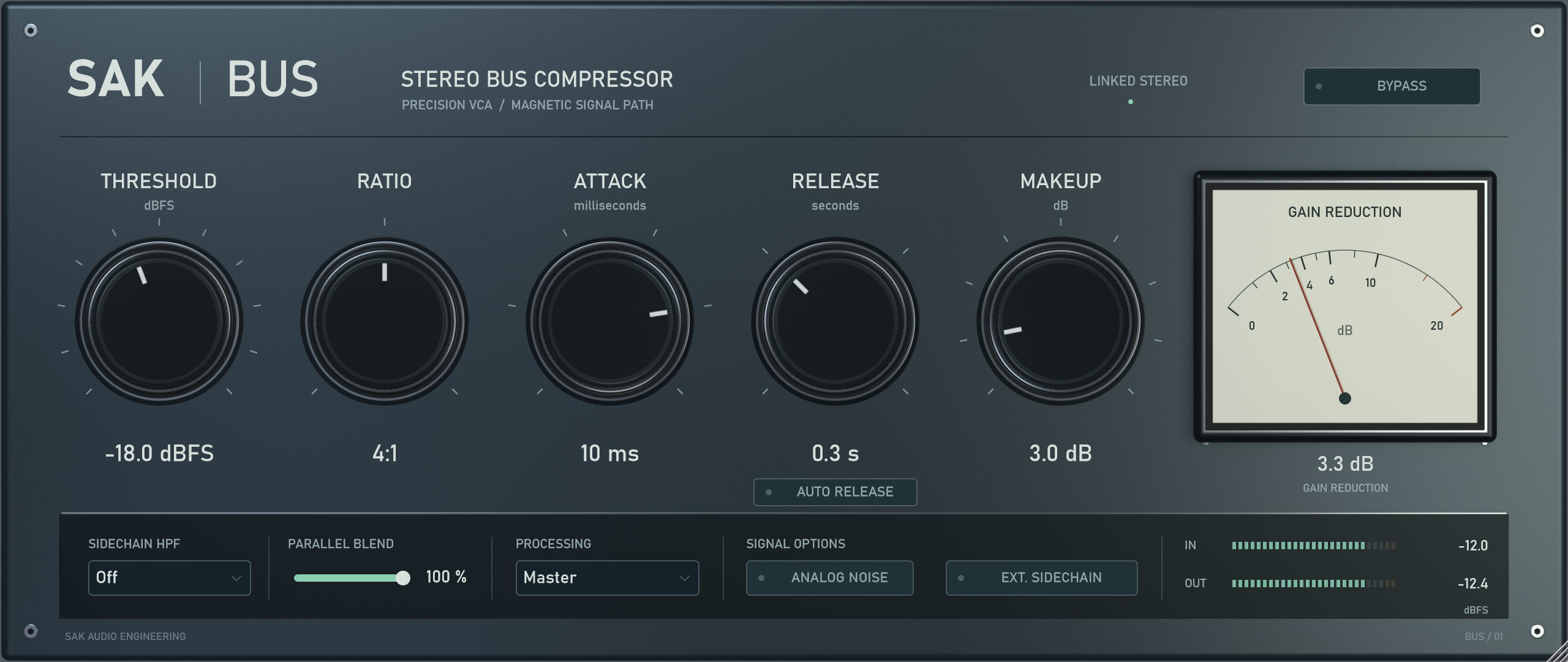
COMPRESSION / WITH CONTEXT
Let the attack through. Set how the next phrase recovers. Bring the dry signal back when the compressed path has done enough.
Start with 4:1, 10 ms attack and Auto Release. Lower Threshold for a few decibels of reduction, then match the listening level with Makeup. The input and output magnetic stages remain part of the path, even when the meter is barely moving.
SAK-BUS draws on the SSL 82E26/82E27 feedback/control topology. Its modern complementary VCA, magnetic stages and ratio calibration are deliberate SAK design choices. It is not an exact vintage SSL emulation.
SIGNAL / CONTROL / STATE
After the circuit: decimation, latency-aligned parallel blend and bypass. Output-driver load feedback uses the previous internal sample; each transformer’s magnetic winding solve is implicit in the current sample.
THE SHORT VERSION
Independent active full-wave rectifiers feed a loudest-channel link. Opposing stereo signals cannot cancel in a summed detector. The sidechain HPF changes what drives compression; it leaves the audio path intact.
The timing voltage drives the audio VCAs and a tracking sidechain VCA. A same-sample implicit solve closes the feedback-like control loop. Ratio, threshold, rectifier conduction and timing resistance interact.
Auto Release uses two coupled RC branches sharing a charging current. A short peak and a sustained passage leave different stored voltages, so they recover differently.
An analytical Blackmer-style log/antilog reduction retains finite branch current, calibrated trim imbalance, gain-dependent distortion, offsets, noise and slew. It is informed by published VCA analysis and modern THAT 2180A data.
The input and output transformers have separate windings, loads and calibration targets. Jiles–Atherton magnetic history changes magnetizing current inside the winding circuit solve. Makeup changes the physical drive into the output stage.
Studio, Master and Render oversample the interacting signal and control circuit at 2×, 4× and 32×. The magnetic, VCA and timing states stay together. Every mode reports the same 248-sample host latency.
Controls, equations, calibration, measurements and the limits of the model.
QUALITY / FIXED HOST LATENCY
| Mode | Circuit rate | Use |
|---|---|---|
| Studio | 2× | Lower CPU auditioning |
| Master | 4× | Normal-level mixing · default |
| Render | 32× | Offline work and overload |
248 samples in every mode. Dry blend and bypass are aligned. Render can exceed real-time CPU capacity. Analog Noise is optional and off by default.
MEASURED / WITH CONDITIONS ATTACHED
20 Hz–20 kHz response spread
1 kHz THD at +4 dBu
Reported host latency
Production DSP at 48 kHz, Master 4×. Response and THD: unity setting, compression inactive, noise off; −20 dBFS sine = +4 dBu. These are model measurements, not measurements of a historical compressor. See the manual for settling, analysis bandwidth, overload results and reference boundaries.
SAK-BUS / v0.1.1
Free to use. Source and technical manual included.
Windows x64 · tested on Windows 11.
Stereo VST3 and optional standalone application.
Performance update: more efficient circuit solving, with compression and saturation behavior preserved.
Windows x64 · VST3 + standalone
Download for Windows 33.2 MB · WINDOWS INSTALLERUnsigned release. Windows may show a publisher warning. File checksums.
INSTALLATION / PRACTICAL NOTES
The installer places the complete VST3 bundle in C:\Program Files\Common Files\VST3. Documentation and the optional standalone application go in C:\Program Files\SAK Audio\SAK-BUS. Close your audio host before installing, then rescan VST3 effects. Remove it through Windows Settings → Apps.
Enable and route a mono or stereo sidechain bus in your host, then enable Ext. Sidechain. If the host has no enabled sidechain bus, detection uses the internal signal. A connected but silent sidechain intentionally causes no external detection.
The DSP, editor, editable Blender assets, exact JUCE dependency source, measurements, research, manual and reproducible build and installer scripts. SAK-BUS uses AGPL-3.0-only, following SAK-TUBE. Third-party components retain their notices.
Bypass is smoothed and latency-aligned; the internal circuit continues to evolve. Quality changes transfer magnetic and timing state and crossfade. The host is told to retain up to 16 seconds of signal-induced decay.